Today in class, we created an ad demonstrating the effects of caffeine. Even though caffeine may be viewed as a relatively safe substance since it's not only legal but can also be purchased at a coffee shop located on nearly every street corner by even young children, the reality is that caffeine can easily become addictive and has rather negative side effects. Even though caffeine has the ability to stimulate one's mind to allow one to cram for a test or finish a homework assignment, the drug has a tendency to cause insomnia, nervousness, dehydration, and irritability.
One thing that concerns me with caffeinated beverages, specifically energy drinks, is the amount of caffeine each one has. After doing some research, I found a website stating that a 16 oz. can of Monster has about 160 mg. of caffeine, which is "more caffeine than a double espresso". It was really surprising to see that a 16 ounce can of an energy drink has over half of the maximum recommended dose of caffeine daily. Since most consumers are probably not aware of the possible side effects that caffeine has, I feel that all bottled and canned drinks should have a small label warning consumers of the possible side effects that may occur with caffeine consumption.
Wednesday, March 23, 2016
Monday, March 21, 2016
Chicken Dissection
Muscles, bones, and tissues all play important functions in our bodies; for instance, our bones, which are composed of dense connective tissue, are responsible for supporting the body, protecting the body's soft organs, and forming blood cells. Tendons are flexible chords of fibrous tissue that is responsible for attaching a muscle to a bone. For instance, the biceps are joined together by a tendon at the radius and ulna. Muscles are responsible for stabilizing joints, heat generation, maintaining the body's posture, and moving the body's bones and fluids.
Overall, we noticed that the chicken had many functional similarities but had vastly different physical similarities. Because the chicken that we dissected was bred primarily for meat, we noticed that its body was extremely unbalanced and often toppled over, with parts of their bodies (e.g. the pectoralis minor and major) much larger in proportion than other parts of their body. On the other hand, most humans seem to have relatively proportional bodies. Another difference that we found was that the upper limbs of humans are arms while chickens possess wings as their upper limbs. While chickens and humans possess structural differences, both use their upper limbs for the same function. One similarity that we found between humans and chickens is that both possess epithelial, muscle, and connective tissue.
| The pectoralis major is the breast muscle that runs from the shoulder to the humerus |
| The pectoralis minor lifts the wings dorsally which allows the chicken to recover when flying. |
In chickens, the trapezius runs perpendicular
from the backbone to the shoulder of the bird
and is responsible for pulling the shoulders back.
In humans, the trapezius is split in 2 parts.
|
| The deltoid helps the raise the upper arm/wing. The biceps is responsible for bending the arm/wing. The triceps are responsible for straightening the arm/wing. |
| This is the chicken's largest muscle on the posterior side of the chicken's lower wing. In humans, this muscle is responsible for flexing the hand. |
| This is the chicken's largest muscle on the superior side of the lower wing. In humans,this muscle is responsible for pulling the hand back. |
| The biceps femoris lies medial to the inferior section of the iliotibialis and is responsible for flexing the leg. |
| The semimembranosus is inferior and medial to the biceps femoris and is responsible for extending the thigh. |
| The semitendinosus is anterior and medial to the semimembranosus and extends the thigh. |
| The quadriceps femoris lies on the inside of the thigh medial to the sartorius and is responsible for flexing the thigh and extending the lower leg. |
| The gastrocnemius is the primary muscle of the drumstick. In both humans and chickens, the gastrocnemius is attached to the Achilles tendon/ |
| Whole chicken before the dissection |
| An example of some of the chicken's tendons |
Saturday, March 12, 2016
What Happens When You Stretch
In this reading involving stretching, I was able to learn more in depth about proprioceptors, the lengthening reaction, reciprocal inhibition, the stretch reflex, and components of the stretch reflex. When stretching, the sacromere, the basic unit of contraction in the muscle fiber, contracts which causes an increase of the area of overlap between the thick and thin myofilaments. When stretching, the overlapping area decreases which causes an increased length of the muscle fiber and more force to be placed on the surrounding connective tissue. An interesting thing that I learned about in the reading was that overstretching of muscles can exhibit either a positive or negative result on the body; while overstretching may lead to an increase in flexibility, it can also cause an increased risk of injury.
Some quotes that I found interesting in the reading include:
"When you stretch...it helps to realign any disorganized fibers in the direction of the tension. The realignment is what helps to rehabilitate scarred tissue back to health," (1).
In the past, I perceived that people stretched primarily to reduce the chance of injury; however, this quote made me realize that many individuals who have already injured themselves often undergo physical therapy or incorporate various stretches in our for their bodies to heal more quickly.
"Some sources suggest that with extensive training, the stretch reflex of certain muscles can be controlled so that there is little or no reflect contraction in response to a sudden stretch. While this type of control provides the opportunity for the greatest gains in flexibility, it also provides the greatest risk of injury if used improperly," (2).
I thought it was interesting to see that too much stretching can exhibit both a positive and negative effect. While excessive stretching may be beneficial in allowing the muscles to relax and become more flexible, it can also cause further damage.
"When stretching, it is easier to stretch a muscle that is relaxed than to stretch a muscle that is contracting. By taking advantage of the situations when reciprocal inhibition does occur, you can get a more effective stretch by inducing the antagonists to relax during the stretch due to the contraction of the agonists" (3).
This quote was interesting since I originally thought that all types of stretching would inhibit the same result; however, after reading the article, I was able to learn that stretching is far easier what the muscle is relaxed and can also yield more effective results.
Monday, February 29, 2016
Unit 6 Reflection
In this unit, we learned about the body's skeletal system, in which we were exposed to the various joints and their functions, skeletal disorders, bone fractures, and the types of bones we have in our body. I found this unit relatively interesting, specifically the lecture on bone fractures since it was interesting to learn how bone fractures undergo repair; I also want to learn more in depth of the different types of fractures (e.g. an impacted fracture) since I thought it was interesting to see how a broken bone can lead to various fracture types. I also really enjoyed dissecting the owl pellet since I found it enjoyable to compare and contrast human skeletons compared to bird/rodent skeletons. The lab also enabled me to learn, understand, and memorize the different types of bones that the body possesses.
This semester, I feel that I've been learning more efficiently by studying earlier for tests and quizzes and reviewing the lecture material shortly after the lecture to prevent myself from forgetting the material easily. Originally, I would cram last minute for test by sleeping little the night before; however, after learning of the problems associated with a diminished amount of sleep, I've attempted to reverse this by avoiding the urge to procrastinate and sleeping at an earlier time.
| Health bone vs. Osteoporosis |
| Types of Bone Fractures |
| Some bones from Owl Pelt lab |
Thursday, February 25, 2016
Owl Pellet Lab Reflection
Owl Pellet Lab
Today in Mr. Orre's class, we used tweezers and a probe to dissect an owl pellet, which contains various animal's fur and bones. My partner and I found a skull, two mandibles, and a few front/back legs, ribs, in the collection of bones. Since my partner and I found two mandibles, we perceived that there were at least two animals, one being a vole and the other being a mouse. We believed that the first animal was a vole because the skull was about 25 mm long and had a mandible length of about 20 mm which fit the description for the vole's skull; we also found two lower back legs that matched the diagram of the vole's lower back leg. We thought the other mandible belonged to a mouse because it was about 15 mm., which fit the description for the mouse's mandible length.
Similar to humans, both voles and mice possess mandibles, which hold our teeth. We also have a similar appendicular skeleton, with similar parts such as the fibula and tibia. Another similarity that we have with both voles and mice is that they possess craniums, which effectively protects our brain.
However, there are multiple differences as well. For one thing, only the rodents have fur. Also, we noticed that in the leg bones that we found, the tibia and fibula were switched; while the tibia is smaller in humans, it's larger in rodents. Furthermore, rodents have a different hip-bone that we do, because they use it to walk on 4 feet rather than on 2 feet.
Today in Mr. Orre's class, we used tweezers and a probe to dissect an owl pellet, which contains various animal's fur and bones. My partner and I found a skull, two mandibles, and a few front/back legs, ribs, in the collection of bones. Since my partner and I found two mandibles, we perceived that there were at least two animals, one being a vole and the other being a mouse. We believed that the first animal was a vole because the skull was about 25 mm long and had a mandible length of about 20 mm which fit the description for the vole's skull; we also found two lower back legs that matched the diagram of the vole's lower back leg. We thought the other mandible belonged to a mouse because it was about 15 mm., which fit the description for the mouse's mandible length.
Similar to humans, both voles and mice possess mandibles, which hold our teeth. We also have a similar appendicular skeleton, with similar parts such as the fibula and tibia. Another similarity that we have with both voles and mice is that they possess craniums, which effectively protects our brain.
However, there are multiple differences as well. For one thing, only the rodents have fur. Also, we noticed that in the leg bones that we found, the tibia and fibula were switched; while the tibia is smaller in humans, it's larger in rodents. Furthermore, rodents have a different hip-bone that we do, because they use it to walk on 4 feet rather than on 2 feet.
![]() |
| Mouse Jawbone |
| Remaining Fur |
| Collection of leg bones |
Wednesday, January 27, 2016
Unit 5 Reflection
In this unit, we learned about diabetes, obesity, and how the various systems in our body are affected depending on how often we consume food. When our body doesn't receive enough energy from food for long periods of time, it relies on adipose storage and eventually muscle tissue; this shows that constantly skipping meals can be problematic for the body. Yet, eating too much can be detrimental to one's health as well. Obesity is the primary cause to numerous diseases such as Type II diabetes, which affects almost 8% of the population. Unfortunately, diabetes increases one's chance of heart disease or stroke and can cause kidney disease and amputations. We also learned about some of the body's systems, including the endocrine, digestive, and lymphatic system. For instance, the lymphatic system is responsible for protecting the body from foreign cells, absorbing lipids, and recovering fluids.
I found the lecture on fuel metabolism to be quite challenging because it was difficult memorizing what happens in each of the three states and the functions of the various organs and hormones because there were a lot of important details. On the other hand, I felt that the endocrine system was easier for me because a lot of the terms were already used in the unit or in previous units.
We completed a couple projects during this unit, which included a poster where we discussed the fed, fasting, and starvation state as well as an activity where we measured out the length of our digestive systems. It was really surprising to see that the length of my digestive system to be almost the width of the room. We also did a reading regarding the increase in type II diabetes in the United States due to the lack of exercise and poor diet choices. This was really interesting to read since I hadn't really realized that the number of diabetes cases were rising so rapidly.
While reading a couple posts from the discussion commenting homework, I came across an article that said that fasting could actually be beneficial to the body. After reading the article, I understood some of the reasonings behind it but I was still slightly confused.
For my New Year Goals, I intended to spend more time getting adequate sleep by procrastinating less on completing homework assignments and studying for assessments. This has improved since I've learned to stop putting off studying and completing homework; rather than getting 6 hours of sleeps nightly, I can now usually get 7.5 hours of sleep.
Tuesday, January 5, 2016
Digestive System
Data Table: https://docs.google.com/document/d/1KpQV1cjDSn5hY1noiFzO0kqir8K4N3V2970Hgw0p9hc/edit?usp=sharing
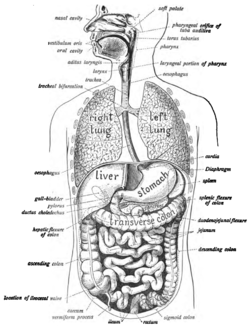
1) In this lab, we measured the lengths of various digestive organs, including the mouth, esophagus, stomach, small intestine, and large intestine. It was interesting to see the lengths of the various organs, specifically the small and large intestine. Also, the lab enabled me to learn about the complexity of the digestive system
2) While my digestive system is 866.27 meters, it's able to fit into my body because the small and large intestines which make up the majority of the digestive system are coiled up and fit in the abdomen.
3) I originally thought that it would take 24 hours for the food to pass through the digestive system. According to this article, it takes from 24-72 hours for food to be fully digested. The time it takes for the body to digest food can be influenced by a variety of factors, specifically diet and exercise. By eating fiber-rich foods and constantly exercising, it takes a shorter time for the food to move throughout the body. However, taking prescription drugs, smoking cigarettes, and drinking caffeine causes a delay in digestion.
4) Digestion is the mechanical and chemical breaking down of food into smaller components that can be absorbed into the bloodstream and involves the stomach. On the other hand, absorption involves the small intestine (gallbladder) where most of the nutrients from ingested food are absorbed.
Subscribe to:
Posts (Atom)