
Monday, October 26, 2015
Monday Wellness Blog Post
Snacking plays an important part of one's health; however, overeating unhealthy, processed snacks are problematic. One should eat a healthy snack 2-3 times about 2-3 hours before each meal to prevent overeating. Healthy snacks are generally less than 200 calories, have 10 grams of protein, and have at least 5 grams of dietary fiber. Some unhealthy snacks include chips, candy, and soda pop, which generally are deemed "empty calorie foods" because they have little nutritional value and are generally filled with artificial colours, unnatural sugars, and very few vitamins. Overall, this Monday Wellness enabled me to realize that snacking it a healthy part of one's diet; however, one should be careful about what they consume during a snack.


Wednesday, October 14, 2015
Heart Rate/Blood Pressure
https://docs.google.com/document/d/1JivpT3t9gwK5lB-wJrFd2wnRj15CGl4nQQVS6WHhkag/edit
(Data Table for Heart Rate and Blood Pressure)
In class today, we learned how to measure blood pressure and heart rate. While both require the use of a stethoscope, measuring blood pressure also requires the use of a sphygmomanometer, or blood pressure cuff. To measure blood pressure, one rolls up his or her sleeve past the elbow and extends their arm, palm up. The other person deflates the air bladder of the cuff and wraps it around the first person's arm and places the head of the stethoscope under the edge of the cuff. After, one inflates the cuff until it reaches about 150 mmHg. The measurer should watch the pressure gauge and concentrate on hearing a slight noise that usually appears between 110-140 mmHg, or the the systolic blood pressure. When the noise stops, the number on the pressure gauge is the diastolic blood pressure. While the systolic pressure is the result of the ventricles contracting, diastolic pressure occurs during ventricle relaxation.
On the other hand, measuring heart rate is less complex, where one can measure it by measuring their pulse. However, one should not measure their pulse using his or her thumb because the thumb has its own pulse, so it would be difficult to determine the correct heart rate.
Thursday, October 8, 2015
Unit 2 Reflection
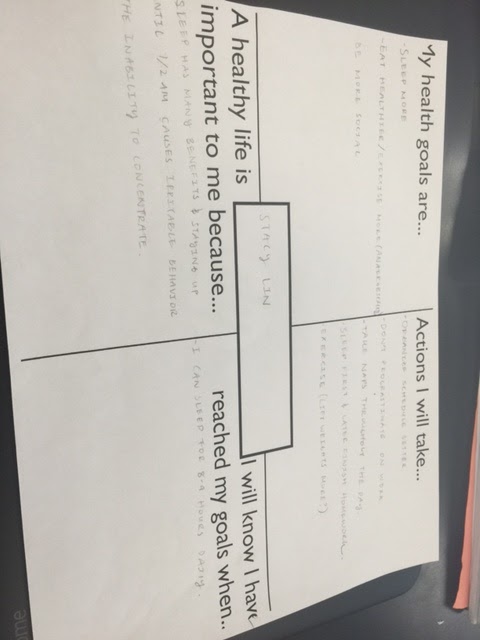
Overall, health is attempting to find a balance with mental, social, and physical health, where one must receive enough sleep, incorporate varied types of exercise, have limited amounts of stress, communicate with others, and have a proper diet. These aspects greatly affect our body's efficiency and overall well-being. While our school attempts to incorporate a healthy atmosphere for the students, many are not getting the recommended 9-10 hours of sleep due to the increased amount of stress from homework and tests/quizzes. However, this can easily be changed by altering our schedules and procrastinating less on assignments.
Some essential themes in this unit include getting adequate nutrition and getting proper sleep. Filling our lives with processed foods and limiting our sleep causes issues, including increase in stress and weight. While the majority of the chapter seemed related and easy to comprehend, I was slightly confused on identifying whether a person is in non-Rem/Rem/awake phases through the varied graphs. To improve this, I would look more closely at the examples in the classwork.
This unit relates to my intended college major, psychology, where one studies the way people think/behave. Many of the issues covered in the unit, including sleep (Rem/non-Rem sleep, Sleep Stages, Cortisol, Melatonin), social health (communicating with others instead of chatting through social networking websites), and nutrition (limiting processed foods and getting a balanced diet) related to some of the psychology classes I took in the summer, including Social and Abnormal Psychology.

Sunday, September 20, 2015
Nutrition Analysis
After interpreting the results from the diet results from Food Tracker, I learned that I need to alter my diet through eating more calcium-enriched foods and finding an equal balance between fruits and vegetables. Through the Falcon Market lab that we did in class, I learned that several foods, such as various snacks, frozen meals, and fast food, are high in trans fat, sodium, carbohydrates, and sugar, showing that although they are less time-consuming to prepare, they can lead to several health problems, including obesity, heart disease, and diabetes. Furthermore, several Starbucks drinks are bombarded with large amounts of fat, sugar, caffeine, and even sodium; these caffeinated drinks not only dehydrate the body but also fill our diets with hundreds of empty calories.
Currently, I'm eating about the right amount of protein and carbohydrates; however, I've noticed that I often eat excess fruit or vegetables and not enough of the other. In order to change this habit, I could eat some fruit or vegetables as a snack, or incorporate it into my meal. Also, I realized that I haven't been including enough calcium in my diet. In order to increase the amount, I could add a slice of cheese to my sandwich at lunch or eat some yogurt for breakfast.
The goal to having a healthy lifestyle would be to have a balanced diet, filled with protein, carbohydrates, calcium-enriched foods, fruits, and vegetables, with less than 2300 mg of sodium. Although this can be difficult with eating processed foods (snacks, frozen meals, fast food, etc.), it can be easily accomplished through eating freshly made foods. Contrary to processed foods, freshly made foods are filled with more vitamins and nutrients and less unhealthy fats (trans/saturated fats) and sodium. Furthermore, one should drink several cups of water daily (6-8 cups) instead of unhealthier alternatives such as soda pop, juice, and coffee since these are often filled with excess caffeine or sugar.


Tuesday, September 15, 2015
Health Unit 2

This week, we started our unit on Health. We learned about the 5 pillars of health, which states that having 5 pillars of health , have adequate exercise, maintaining a balanced lifestyle, getting enough sleep, and interacting with others. While I feel that I have been able to maintain a balanced lifestyle with classes and activities, I feel that I could improve on getting enough sleep.
Tuesday, September 8, 2015
Unit 1 Reflection
In the first unit of Anatomy and Physiology, we learned about the structure and function of the body, the various anatomical terms, the biological molecules, and histology. Through learning more in depth about the presence of different macromolecules and their arrangement directly affecting the behavior of the cell and its corresponding tissue, I learned about the 4 types of tissues (epithelial, connective, muscle, and nervous) and about the biological molecules (nucleic acids, lipids, proteins, and carbohydrates). While I was able to learn a lot through the first 3 weeks of school, I am still slightly confused of how to differentiate between the different types of tissues (e.g. the different types of cartilage) because they all seem somewhat similar. In the next few units, I hope to read the book and read the notes in order to gain more knowledge on certain topics.
Since a couple of my family members suffer from Pre-diabetes and Type 2 diabetes, I thought it was interesting to learn about the 3 types of carbohydrates (monosaccharides, disaccharides, and polysaccharides (complex carbohydrates)). I found it interesting to complete the Sweetness lab, where we sampled various types of carbohydrates such as glucose, sucrose, and lactose. Through completing the lab and learning about the carbohydrates in notes/lectures, I was able to think more in depth about how individuals with diabetes were negatively affected by the disease.
Sunday, September 6, 2015
Tissue Lab
After completing the Tissue Lab, I was able to get a get a better understanding on the different types of cells and tissues. By seeing the nucleus and various organelles of the various tissues, I was able to make a connection between what I learned about the function of the tissue. While the connective and nervous tissue looked very smooth, it seemed to be very scattered. However, the muscle tissue had a clearly defined shape. The epithelial tissue seemed to be composed of several layers and had a distinct shape; however, it wasn't as distinct as the muscle tissue was.
For instance, the bone tissue resembled a large mass of cells instead of a single cell. Since bones play a vital role in supporting the body and controlling both involuntary and voluntary movement, the microscope image clarified the fact that bone cells are composed of several cells.
Similarly, the blood smear slide was composed of several dots that had a slight distance in between them. By being located throughout the body, the blood cells are able to transfer nutrient and hemoglobin throughout the body.
Some of the cells we looked at in class


Subscribe to:
Posts (Atom)